

Fact Check
President Anura Kumara Dissanayake made two related claims about the government’s financing of LKR 500 billion for Cyclone Ditwah recovery: (1) it was from an existing Treasury [cash] balance of LKR 1,200 billion (or LKR 1.2 trillion), and (2) it was not drawn from borrowing or money printing.
To assess both claims, FactCheck.lk reviewed the Ministry of Finance’s Annual Reports and the Budget, Economic and Fiscal Position Report 2026, focusing on the latest available data for 2025.
On the Treasury balance: The above sources confirm that by August 2025, the Treasury held a cash balance of approximately LKR 1,200 billion. This indicates that the government was able to finance Ditwah-related expenditure in 2026 using existing funds, without raising additional borrowing at that point. In this narrow sense, the president’s claim is factually correct.
On the “no borrowing” claim: This claim is incorrect on two counts.
First, the allocation involved borrowing — just borrowing that happened earlier. The Treasury’s cash balance was built through excess borrowing in prior years, not through excess revenue left after meeting its expenses. As shown in Exhibit 1, gross borrowing exceeded the combined needs of debt repayments and the budget deficit by LKR 605 billion in 2022, LKR 642 billion in 2023, LKR 131 billion in 2024, and LKR 405 billion by August 2025. These accumulated as cash balances in the Treasury. The funds used for Ditwah recovery, therefore, ultimately came from borrowing, even if not from new borrowing raised at the time of this allocation.
Second, spending that buffer now affects future borrowing needs. The government’s own 2026 borrowing plan had already earmarked LKR 500 billion from this same cash reserve to repay maturing treasury bills without borrowing afresh for that purpose. This shows that the cash buffer could have been used to reduce future debt repayments without new borrowing. Using that same buffer instead for Ditwah recovery reduces that capacity. In other words, the more of the reserve is spent now, the less it is available later to repay maturing debt without fresh borrowing.
In sum, the president is correct in a narrow sense: the government did not need to raise new borrowing at the time of the allocation as there was sufficient cash reserve in the treasury. But the broader claim—that spending allocation involves no borrowing—is not correct. The cash reserve being spent was itself built through past borrowing, and the spending of that, instead of using it to retire debt, results in requiring to borrowing more in the future.
Therefore, we classify the president’s statement as PARTLY TRUE.
*FactCheck.lk’s verdict is based on the most recent information that is publicly accessible. As with every fact check, FactCheck.lk will revisit the assessment if new information becomes available.
Additional Note: The government has also obtained loans after the supplementary allocation, which are now specifically for Ditwah recovery. A USD 350 million loan commitment from the Indian government is specifically earmarked for recovery efforts in Ditwah. Furthermore, budget support of SDR 150.5 million from the IMF, under the Rapid Financing Instrument in December 2025, was also based on managing the consequences of Ditwah; and the World Bank and ADB have also repurposed their existing loans towards Ditwah recovery. These loans add directly to public debt.
Exhibit 1: Summary of Government Cash Flow Operations
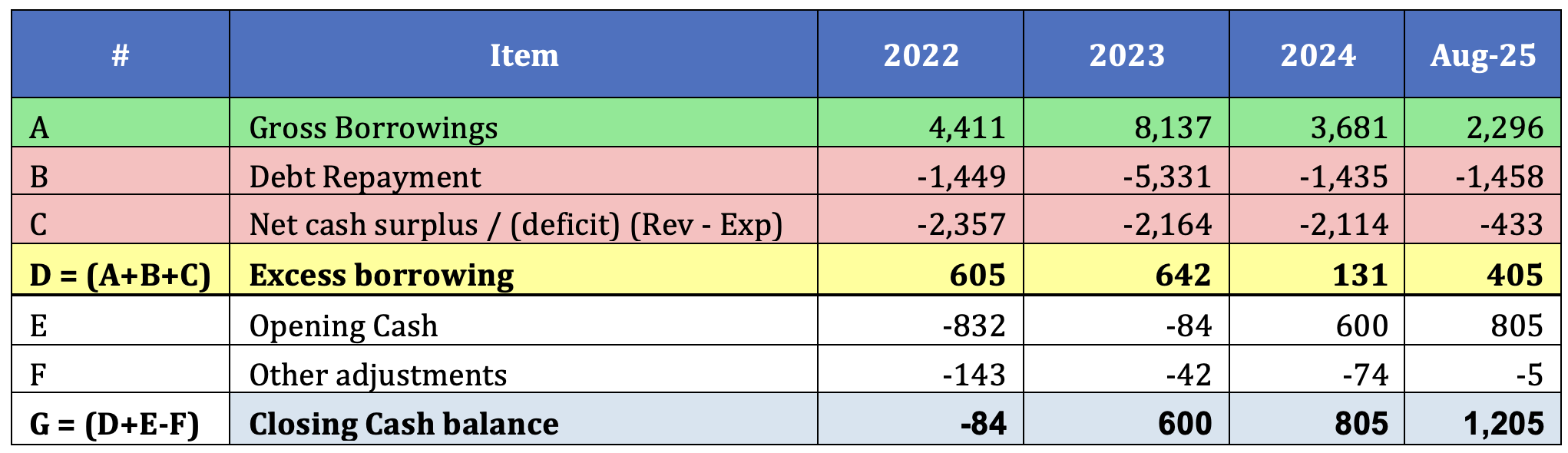
Source: Ministry of Finance’s Annual Reports 2022-2024 and The Budget, Economic and Fiscal Position Report 2026
Sources
- Ministry of Finance, Sri Lanka, Annual Report 2022 at https://www.treasury.gov.lk/api/file/1c6c5c7d-annual-report-2022 [last accessed 24 March 2026].
- Ministry of Finance, Sri Lanka, Annual Report 2023 at https://www.treasury.gov.lk/api/file/annual-report-2023 [last accessed 24 March 2026].
- Ministry of Finance, Sri Lanka, Annual Report 2024 at https://www.treasury.gov.lk/api/file/annual-report-2024 [last accessed 24 March 2026].
- Ministry of Finance, Sri Lanka Budget, Economic and Fiscal Position Report 2026 at https://www.treasury.gov.lk/api/file/budget-economic-fiscal-position-report-2026 [last accessed 24 March 2026].
- Ministry of Finance, Sri Lanka, Annual Borrowing Plan and Debt Management Strategy 2026 at https://www.treasury.gov.lk/api/file/annual-borrowing-plan-debt-management-strategy-2026 [last accessed 24 March 2026].
- International Monetary Fund Sri Lanka: Financial Position in the Fund as of February 28, 2026 at https://www.imf.org/external/np/fin/tad/exfin2.aspx?memberkey1=895&date1Key=2026-02-28 [last accessed 24 March 2026].
- President’s Media Division, Sri Lanka. India extends USD 450 million relief package for rebuilding Sri Lanka programme at https://pmd.gov.lk/news/india-extends-usd-450-million-relief-package-for-rebuilding-sri-lanka-programme/ [last accessed 24 March 2026].