

Fact Check
Speaking at a Samagi Jana Balawegaya (SJB) event, Leader of the Opposition Sajith Premadasa raised broader concerns about the adequacy of Sri Lanka’s reserves. In support of his argument, he claimed that, against a reserve target of USD 14.2 billion to be reached by the end of the IMF programme in March 2027, the country has not achieved even 50% of the required reserves.
To verify this claim, FactCheck.lk consulted the Central Bank of Sri Lanka’s (CBSL) weekly economic indicators and the IMF Country Report No. 25/339 titled “Request for Purchase Under the Rapid Financing”.
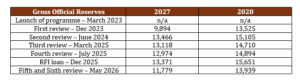
The USD 14.2 billion reserve target figure cited by the opposition leader is higher than what was projected for 2027 in Sri Lanka’s IMF’s programme. The closest projection for gross official reserves for 2027 stood at around USD 13.4 billion at the time of the statement and has since been revised down further (see Exhibit 1).
The substantive question is whether the country’s reserves are, in fact, adequate. The IMF program review documents present a “Assessing Reserve Adequacy” (ARA) benchmark that calculates a minimum level needed for reserves to be considered adequate for each country. The ARA benchmark for Sri Lanka calculated for 2026 is USD 11.5 Bn (see the Additional Note for how it is built).
At the time the Opposition Leader made his statement, reserve data were publicly available only up to February 2026. At that time, gross reserves amounted to USD 7.3 billion, including the People’s Bank of China (PBoC) swap that is subject to conditions of usability, and therefore does not qualify as a reserve asset. Excluding the PBoC swap, gross reserves amounted to USD 5.8 billion. Measured against the ARA benchmark, the USD 5.8 billion figure amounts to roughly 51%.
This calculation supports the Opposition Leader’s claim that Sri Lanka’s reserves are only half the level of what would be considered adequate. Though the Opposition Leader reaches the correct conclusion—that reserves are roughly half the adequate level—he does so using a different calculation, and the numbers he presents to do so (the USD 14.2 billion target and the USD 7 billion as in reserves) are also somewhat overstated.
Therefore, we classify the Opposition Leader’s statement as PARTLY TRUE.
*FactCheck.lk’s verdict is based on the most recent information that is publicly accessible. As with every fact check, FactCheck.lk will revisit the assessment if new information becomes available.
Exhibit 1: Changes to Gross Official Reserve Projections at each review (figures in USD MN)
Additional Note: The Assessing Reserve Adequacy (ARA) metric is the IMF’s estimate of the level of reserves a country should hold to weather a crisis. It is a benchmark amount. As set out in the IMF’s Guidance Note on the Assessment of Reserve Adequacy (2016), it is calculated by adding up four factors that tend to drain reserves when a country comes under pressure: (1) short-term external debt, (2) other external liabilities, (3) broad money supply, and (4) export earnings.
The weight on each component changes with the country’s exchange-rate regime and whether it maintains capital controls. Assuming a free-floating exchange rate with some capital controls in place, as in Sri Lanka, the benchmark is calculated as follows:

Under this metric, the ARA is calculated and if the figure is in the range of 100% to 150% of this benchmark, reserves are considered broadly adequate for precautionary purposes.