


Fact Check
Minister Nalinda Jayatissa claimed that the government bears a fiscal cost of LKR 20 billion per month from subsidising petrol and diesel prices.
To verify this cost claim, FactCheck.lk consulted the Central Bank of Sri Lanka’s (CBSL) Monthly Indicators, and the fuel pricing formula introduced by the Ministry of Finance, which is evaluated monthly by the Fuel Price Tracker published by Verité Research, and government statements on the rupee value of per liter subsidy on petrol and diesel
The government statements say that the per-litre subsidy rates are LKR 20 for petrol and LKR 100 for diesel. FactCheck.lk evaluates whether this would result in a monthly cost of about LKR 20 billion as claimed by the minister.
Using the CBSL Monthly Indicators, FactCheck.lk applied these stated subsidy rates to annual sales volumes of petrol and diesel in 2025 —the most recent full-year data available.
As shown in Exhibit 1, if the same volume is sold in 2026, the estimated subsidy would be LKR 251.75 billion per year, which is equivalent to LKR 20.98 billion per month. This is about 5% more the minister’s stated figure.
The minister’s statement of LKR 20 billion, therefore, seems to project a decline of about 5% in sales relative to 2025 levels. A reduced sales projection would be reasonable given the likely (but not yet calculatable) decrease in the volume of fuel sales due to increase in prices.
Therefore, we classify the minister’s statement as TRUE.
Exhibit 1: Estimated monthly cost of the subsidy.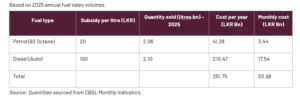 Additional Note 1: Is this an ‘absorption’ by the government?
The minister characterised the subsidy as the government “absorbing” a cost. However, the evidence suggests this is only partially true. For petrol, the subsidy is almost entirely financed by excess tax revenue generated by rising fuel prices — making the characterisation more accurately a waiver of additional tax collection than an absorption of cost. For diesel, only a portion is covered by excess tax revenue, meaning the government is absorbing the remainder.
This is because of how fuel taxes work. Under the fuel pricing formula introduced by the Ministry of Finance, VAT and SSCL are applied as percentages of the landed cost of fuel. When global fuel prices rise, these taxes rise automatically — generating additional revenue the government did not budget for. Between 1 March and 22 March 2026, the increase in landed cost of fuel increased taxes on fuel by LKR 21 per litre for petrol and LKR 31.5 per litre for diesel.
For petrol, this LKR 21 increase almost exactly matches the stated subsidy of LKR 20 per litre. The government is not spending money to reduce the price — it is simply not collecting the extra tax. For diesel, the LKR 31.5 increase covers less than a third of the stated LKR 100 per litre subsidy. The remaining LKR 68.5 per litre represents an actual fiscal cost to the government.
Exhibit 2: Comparison of announced market price and tax-neutral price.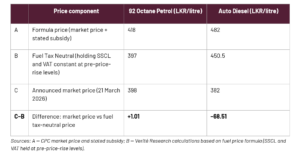
Sources
- Central Bank of Sri Lanka. Monthly Indicators January 2026. Available at : MEI_202601_e.pdf
- CPC Fuel Pricing. Available at: https://ceypetco.gov.lk/marketing-sales/
- Fuel Price Tracker. Available at: https://dashboards.publicfinance.lk/fuel-price-tracker/
- Parliament of Sri Lanka, Live recordings 07th April 2026. Available at: https://www.youtube.com/watch?v=cWm2NgMzUp0