


Fact Check
Speaking to the media on December 4, 2025 MP Mujibur Rahman argued that officials of Sri Lanka’s Department of Meteorology (DoM) had “fulfilled their duties” by issuing timely warnings as evidenced by the DoM’s media briefings from Nov 11 to Nov 23, 2025 that “a situation such as” the one then experienced—Cyclone Ditwah—“could arise” in the country.
FactCheck.lk evaluates this claim by examining whether Sri Lanka’s DoM fulfilled its duty by issuing cyclone-relevant public warnings starting on November 11, 2025.
What counts as a ‘cyclone-relevant’ warning?
Sri Lanka is an original member of the World Meteorological Organisation and the Economic and Social Commission for Asia and the Pacific (WMO/ESCAP) Panel on Tropical Cyclones, under which the Regional Specialised Meteorological Centre – Tropical Cyclones New Delhi (RSMC-TCND) co-located with the India Meteorological Department’s Cyclone Warning Division, provides the authoritative regional basis for cyclone monitoring and advisories. In RSMC-TCND’s terminology, “cyclogenesis” refers to the development of systems to depression stage or above, with depression-and-above treated as “cyclonic disturbances.” For this fact check, a warning is considered ‘cyclone-relevant’ only from the point when it communicates a plausible path toward depression or higher, not merely the presence of rain-bearing low-pressure areas.
When did DoM first issue a public cyclone-relevant warning?
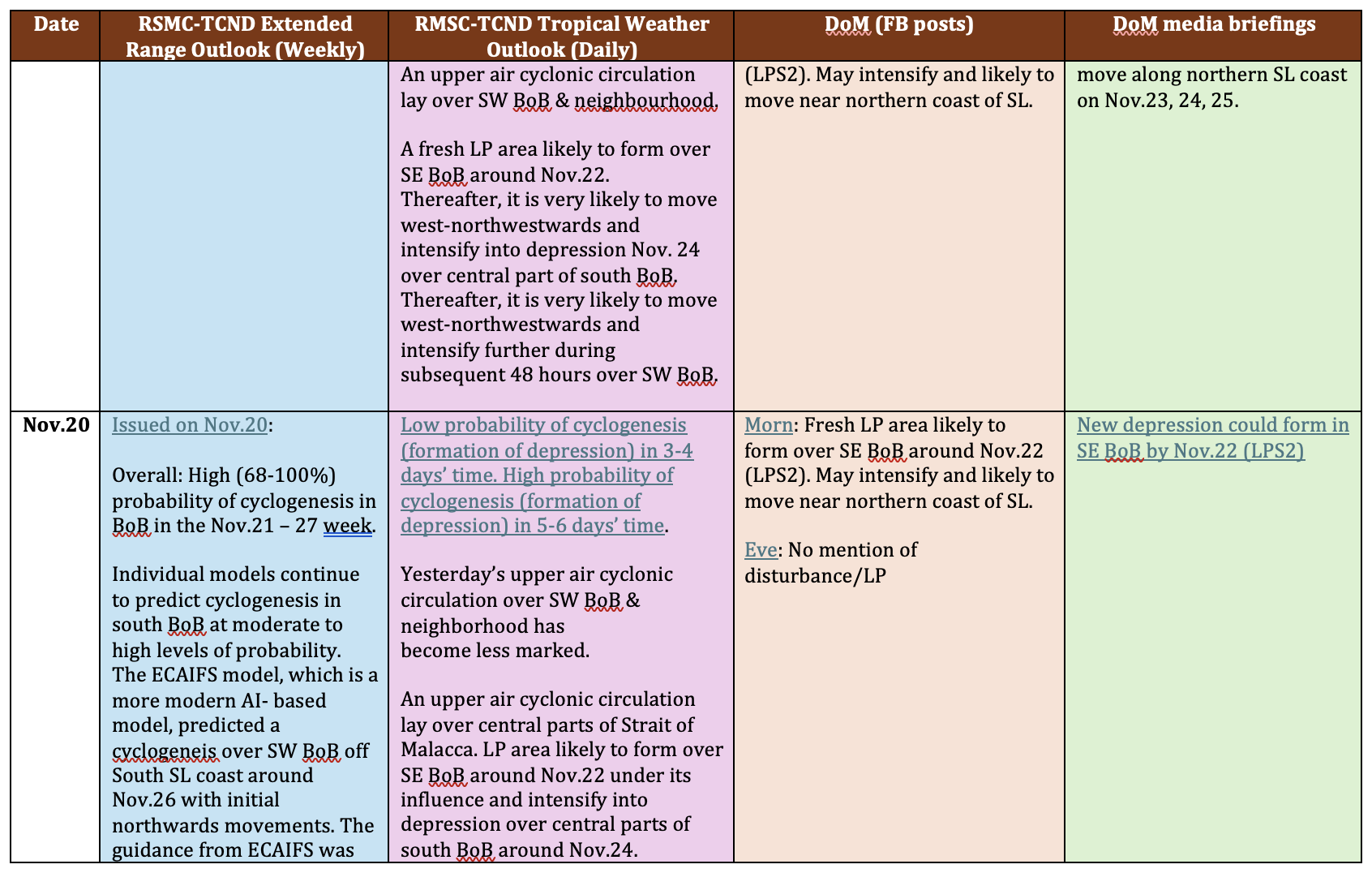
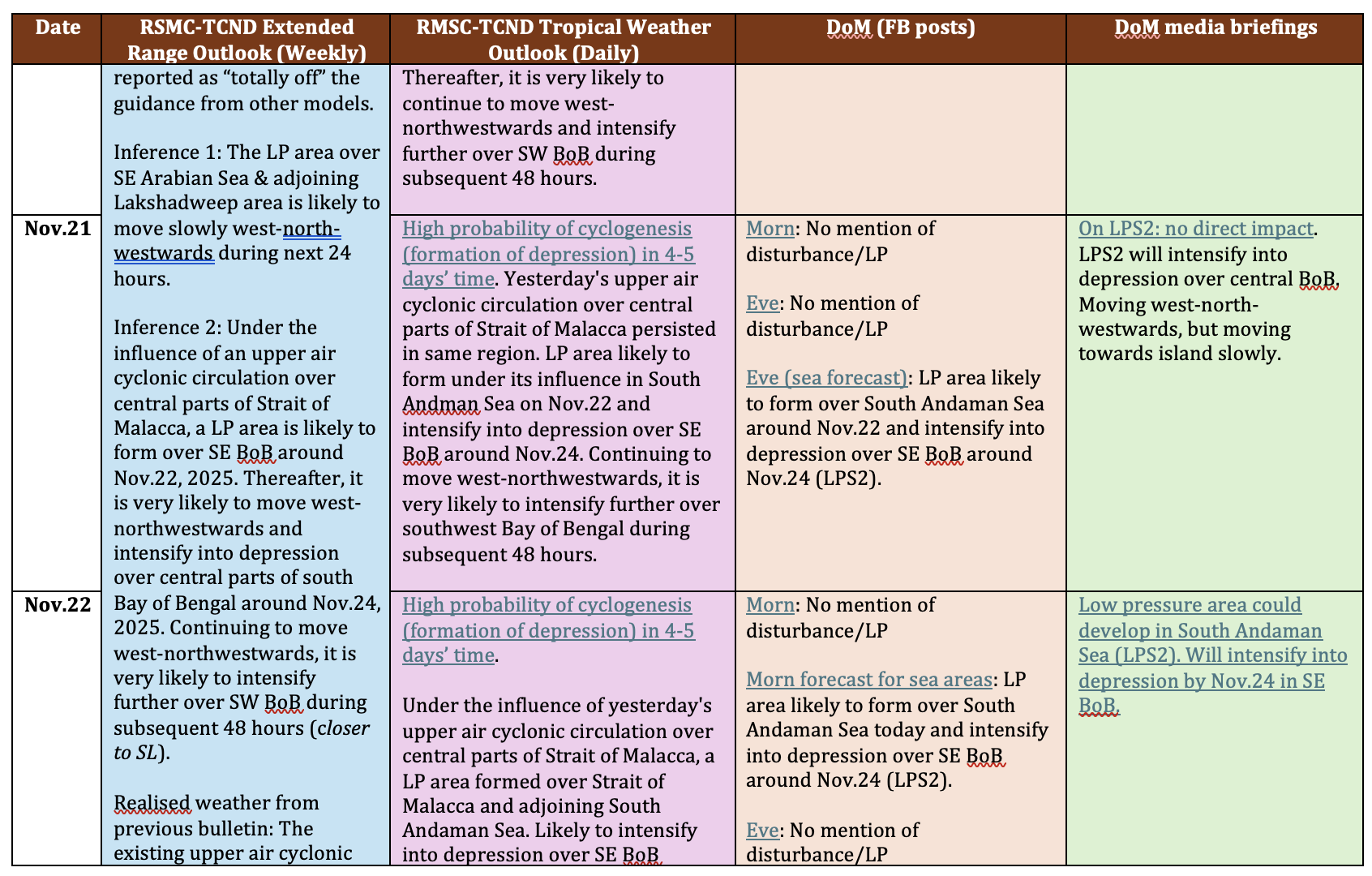
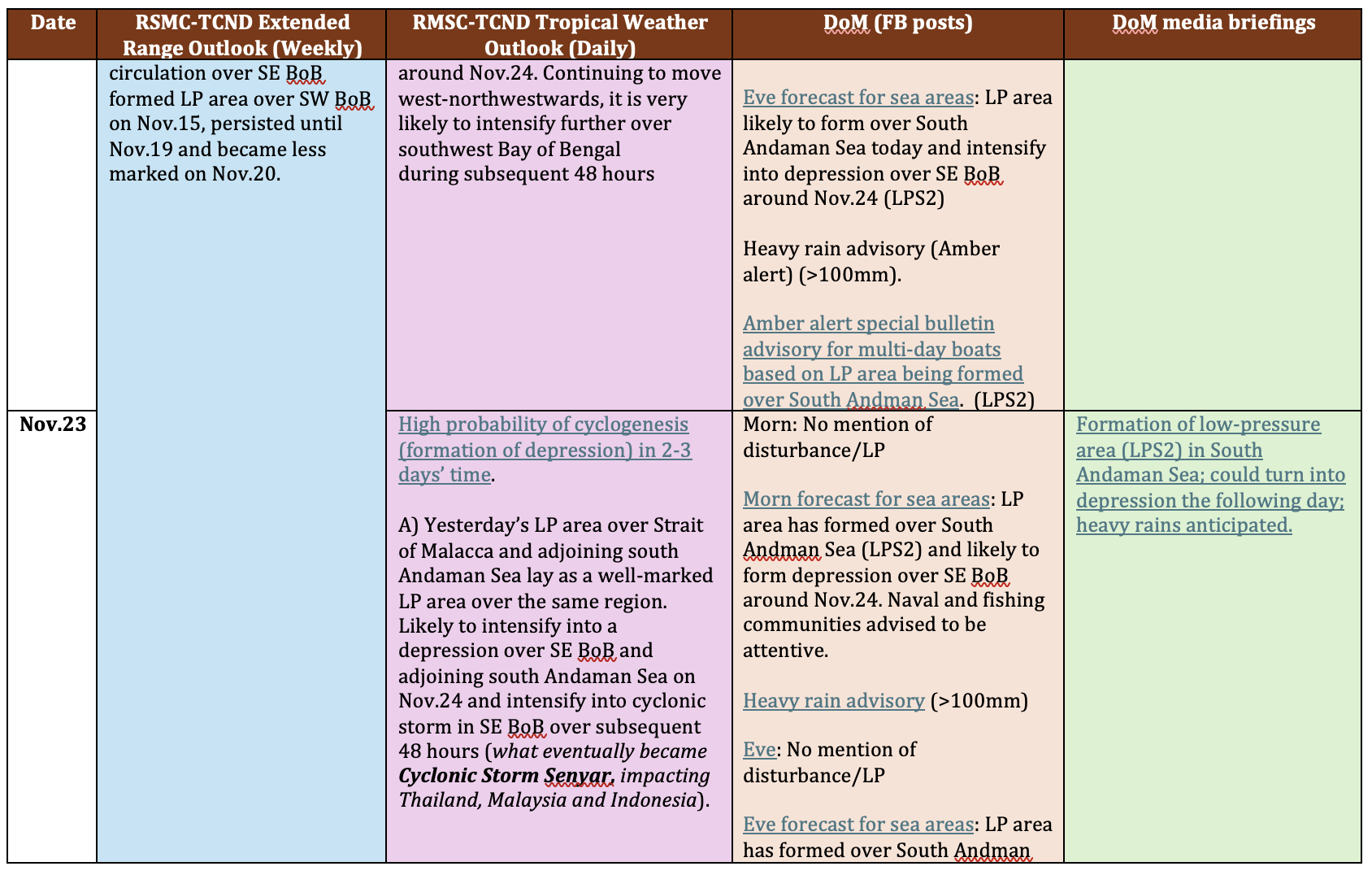
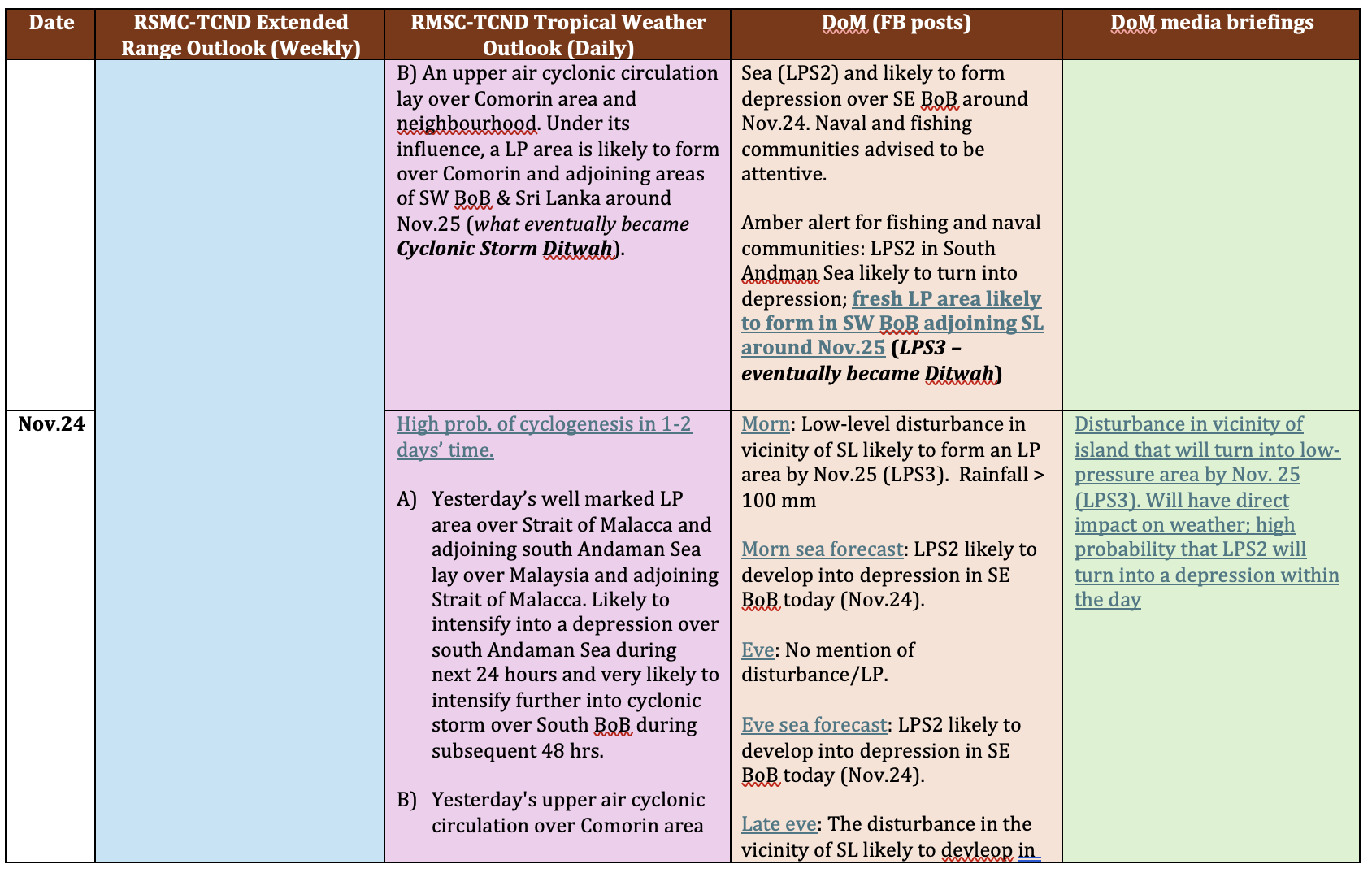
Publicly available DoM official forecasts reviewed for this fact check are posted daily on its official Facebook page. These show that the first clear cyclone-relevant warning (where the term “depression” is mentioned) appears on Nov 21 on the sea forecast (but not weather forecast). We also examined media briefings by the DoM from various news channels, but which were not posted on its official pages. A cyclone-relevant warning for fisherfolk was conveyed in the media briefing on Nov 20. There is no cyclone-relevant warning from the DoM prior to that, and none on the daily weather forecast until November 25, when a special update was issued on the weather system.
Accordingly, the MP’s specific timeline claim is incorrect: the DoM did not issue cyclone-relevant warnings “from Nov 11.” The earliest such official warning on record is Nov 21, and the earliest from media briefings is Nov 20, not Nov 11.
Did DoM have adequate information to issue cyclone-relevant warnings earlier in the Nov 11-19 window?
The MP’s broader defence (that [the DoM] “fulfilled their duty”) could still be true even if his start date is incorrect—if cyclone-relevant information simply did not exist earlier. But the evidence indicates that cyclone-relevant information relating to Ditwah existed in the authoritative outlook of the RSMC-TCND, before DoM’s first cyclone-relevant public warning.
The RSMC-TCND’s Extended Range Outlook (Cyclogenesis), issued on Nov 13, had a cyclone-relevant warning as arising between Nov 21-27, with a low-to-high probability of 40-60% in the South Bay of Bengal and areas close to Sri Lanka. The RSMC-TCND’s own Preliminary Report on Ditwah and its Annual Report for 2025 (Section 2.16.3, p. 286; Section 4.3.4.1, p. 363) also state that Ditwah was monitored from Nov 13, about “13 days prior to the formation of a depression on 26 November.”
In short, cyclone-relevant information existed from Nov 13, but it was not reflected in official DoM forecasts released until Nov 21 (and not in any form until Nov 20).
The available evidence does not support the MP’s claim that officials “fulfilled their duties” by issuing cyclone-relevant warnings from Nov 11. First, DoM did not issue cyclone-relevant warnings from Nov 11; the earliest clear cyclone-relevant warning appears on Nov 20 in its media briefing. Second, cyclone-relevant information relating to Ditwah existed in the authoritative outlook of the RSMC-TCND from Nov 13, even though the DoM did not communicate the same in its official weather forecast till Nov 25.
Therefore, we classify the MP’s claim as FALSE.
*FactCheck.lk’s verdict is based on the most recent information that is publicly accessible. As with every fact check, if new information becomes available, FactCheck.lk will revisit the assessment.
Additional Note 1: RSMC-TCND’s Annual Report for 2025 mentions that the forecasts for the cyclone were based mainly on the multi-model ensemble (MME) technique developed by the IMD. According to Ganesh et al. (2019) the MME is capable of tracking and capturing the signature of the genesis up to about 11-12 days prior to cyclogenesis, with some limitations in the accurate prediction of genesis location. This was borne out in the prediction of cyclone Ditwah as well.
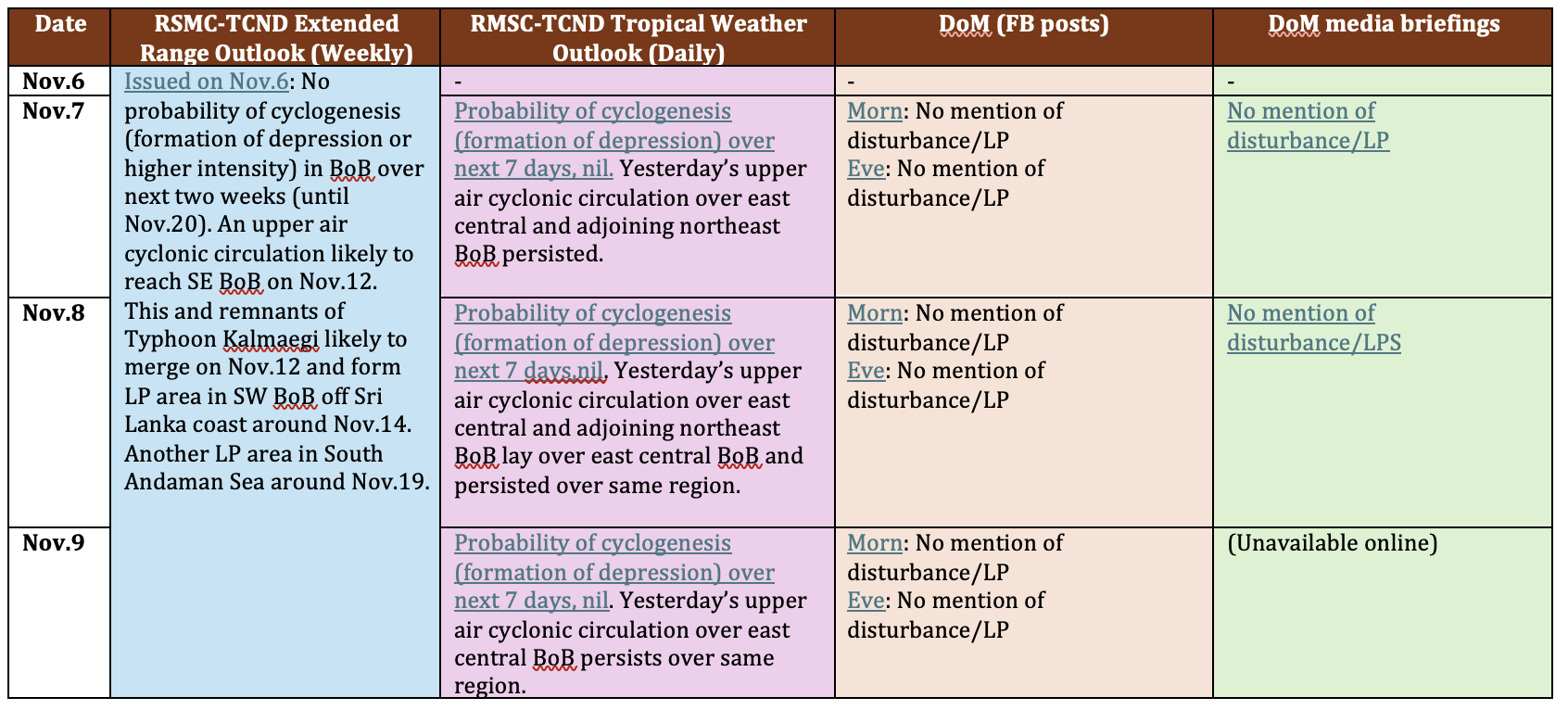
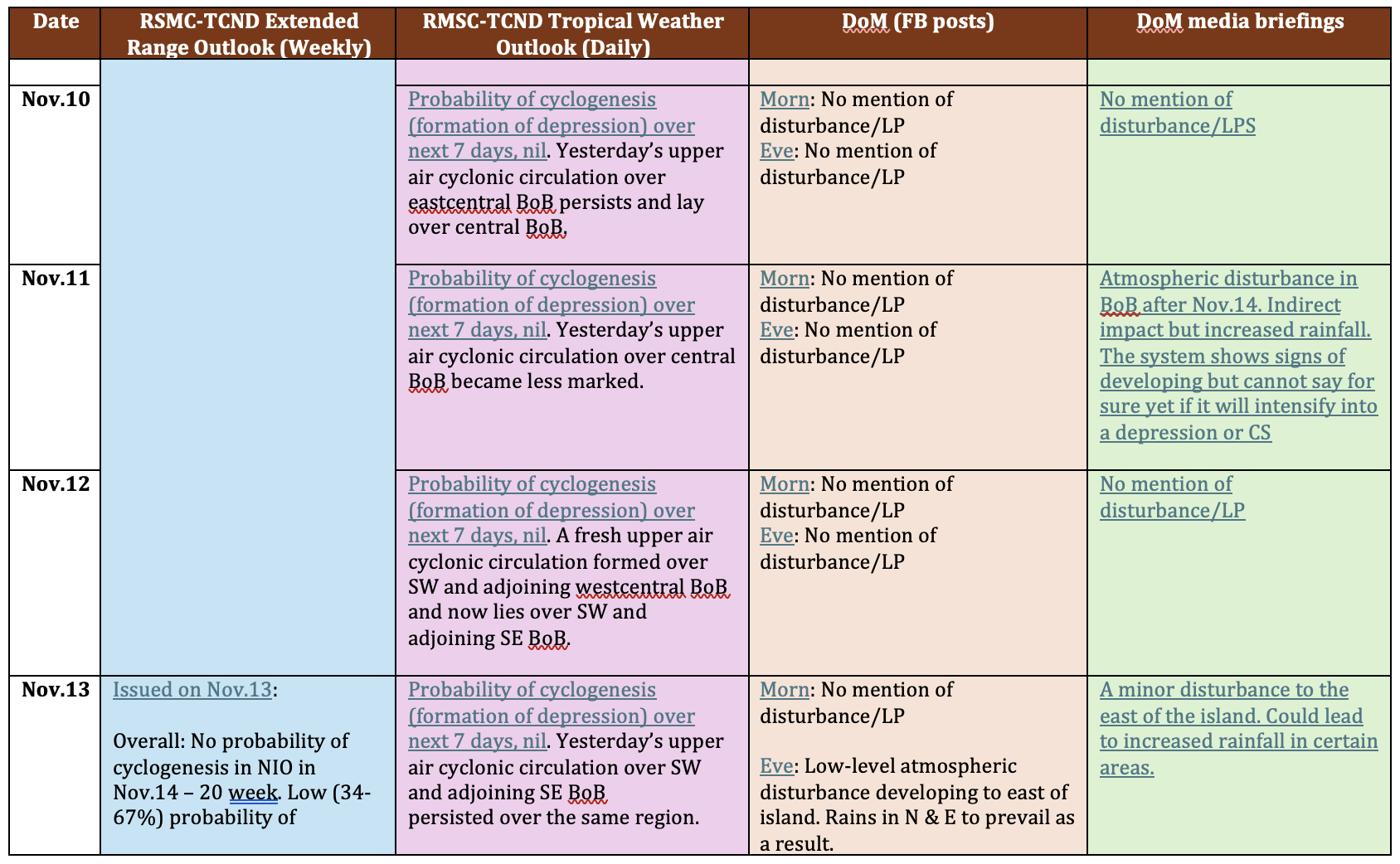
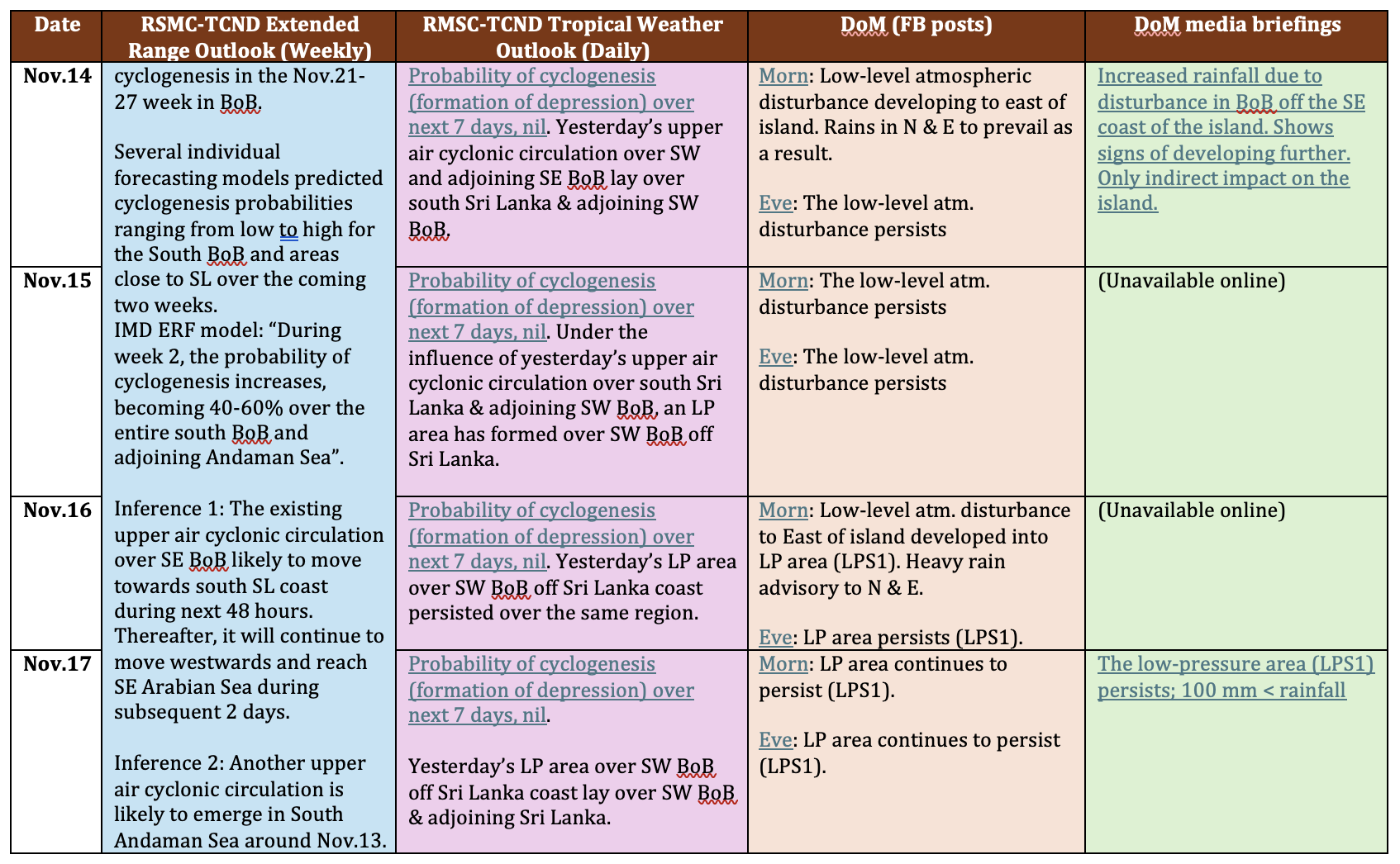
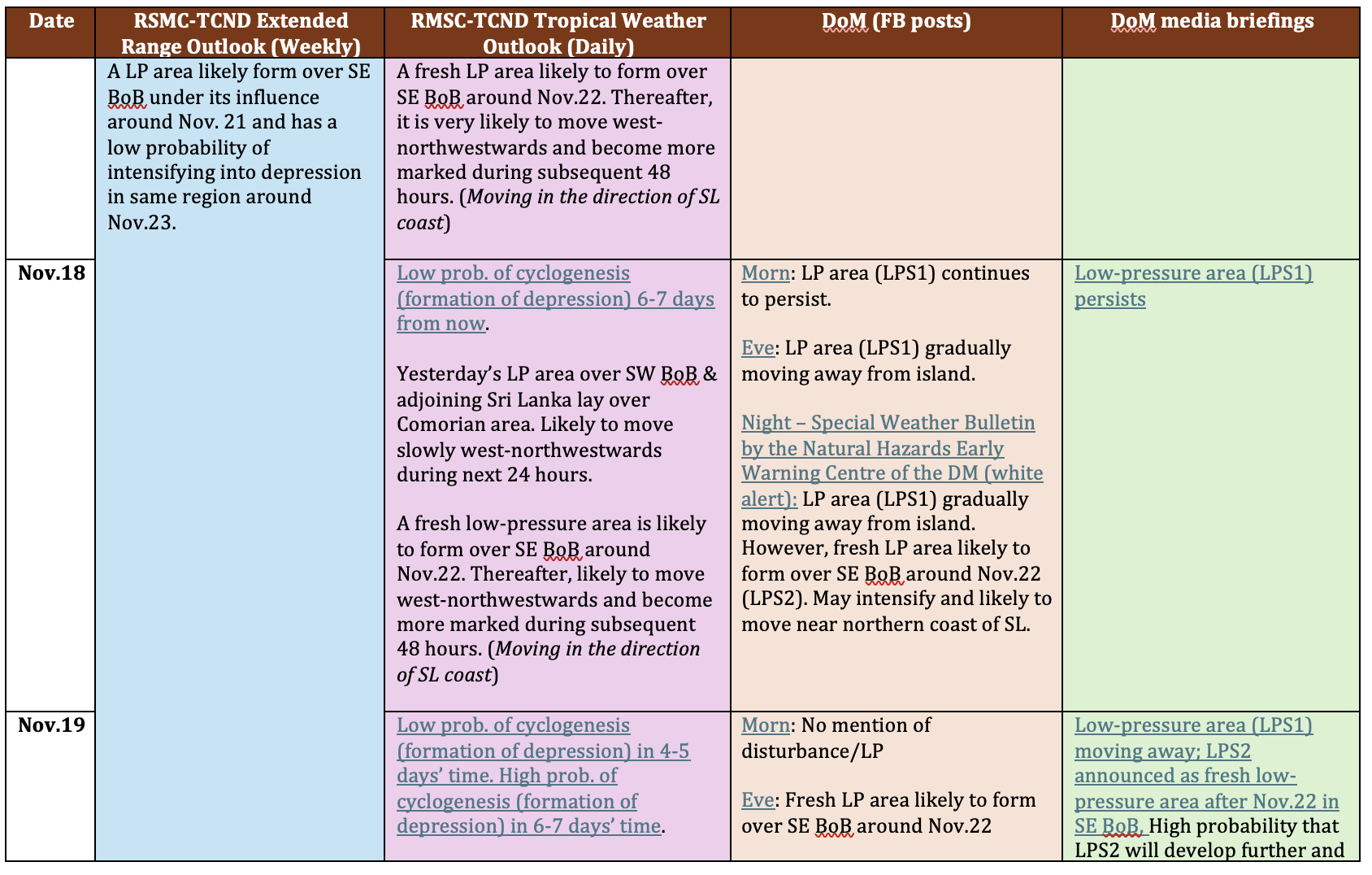
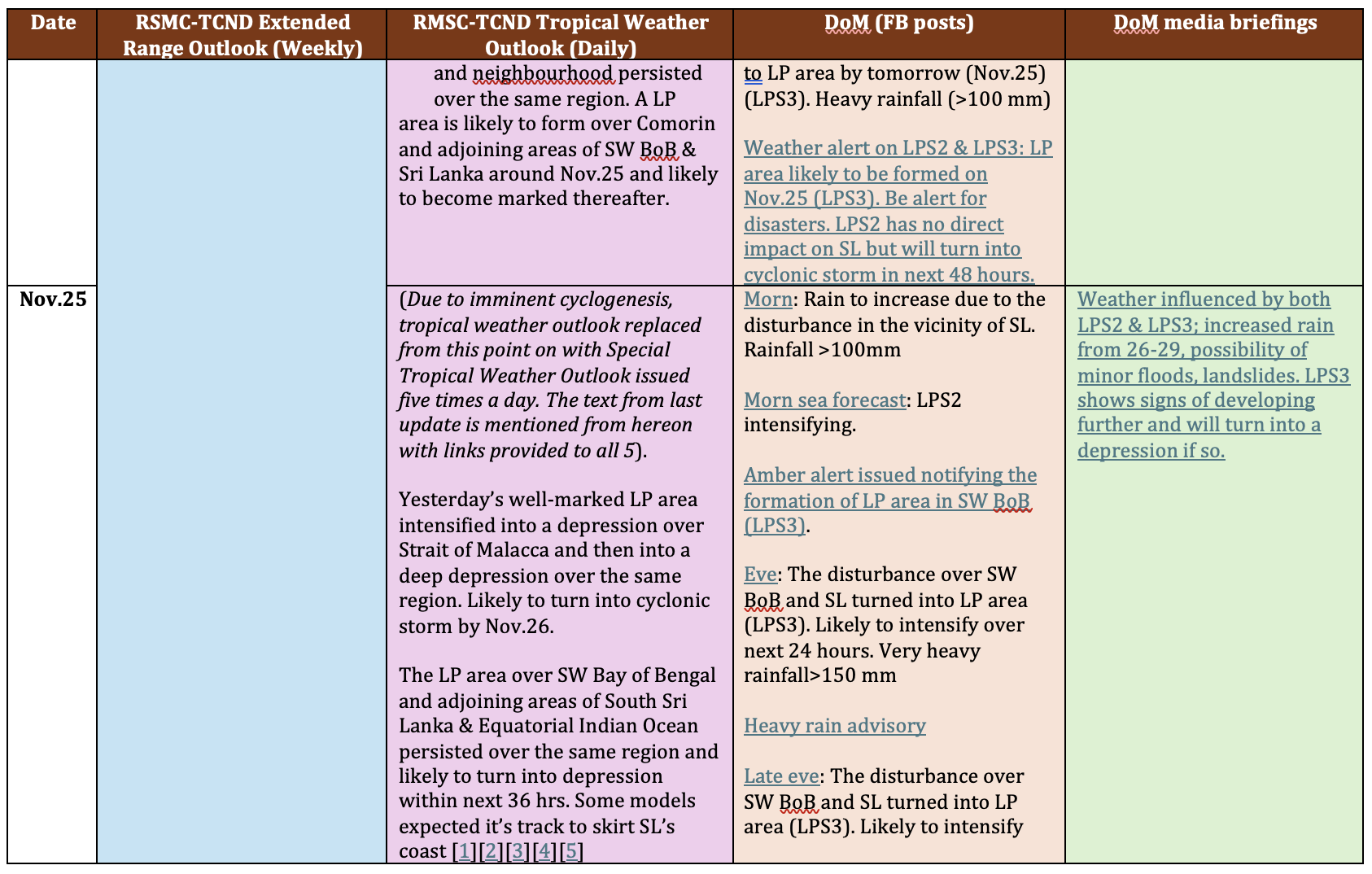
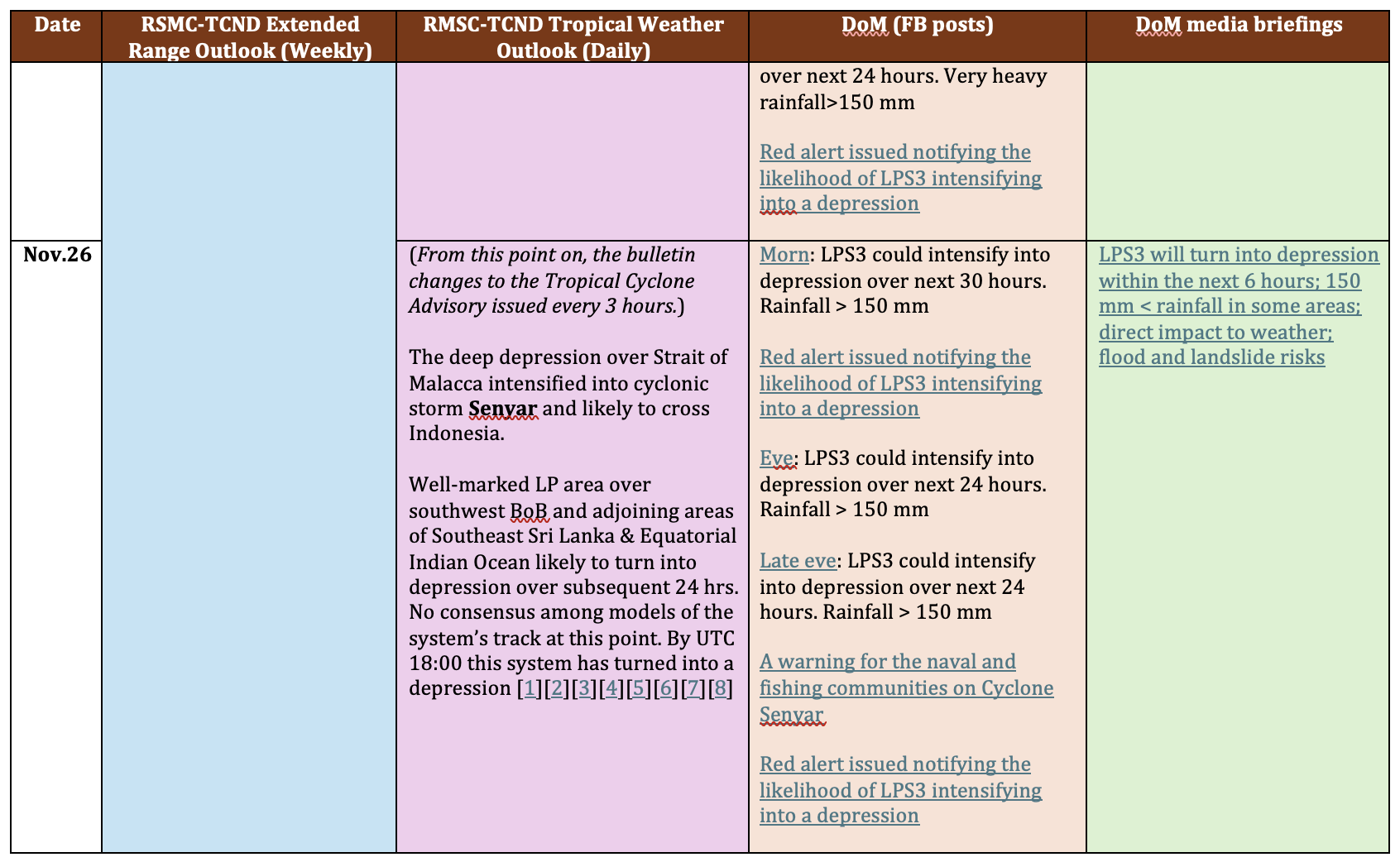
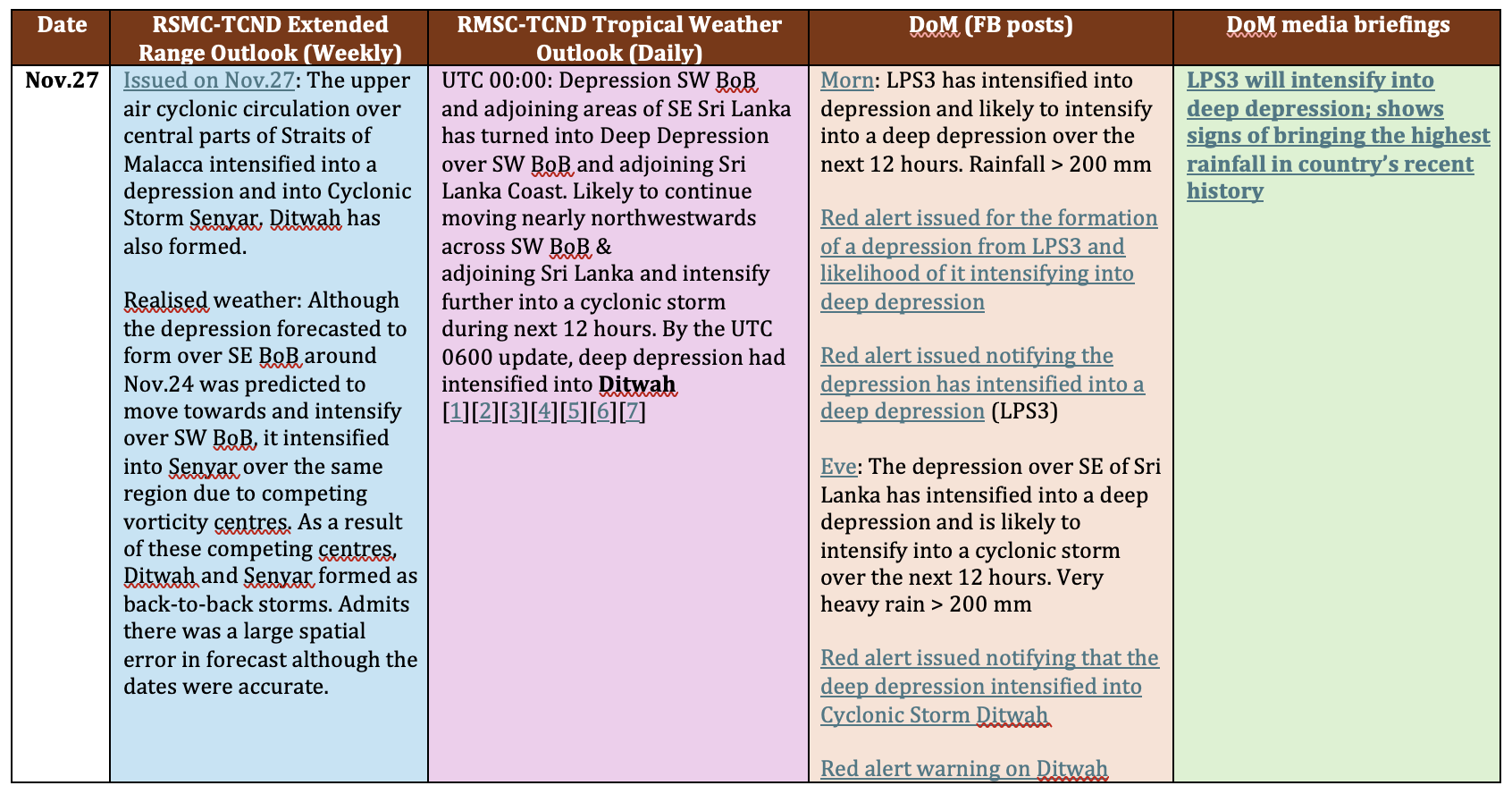
Table 1: Timeline of low-pressure systems and cyclogenesis outlooks and warnings (RSMC-TCND and DoM), 6–27 November 2025
** The table below includes only information relevant to low-pressure systems and possible cyclogenesis. FactCheck.lk’s comments are italicised. In late November, DoM issued multiple Facebook notices as Ditwah developed; for brevity, we include only posts that signalled a change in the system. Sri Lanka was influenced by three Bay of Bengal low-pressure systems in November 2025, culminating in Cyclonic Storm Ditwah. This document sets out comparative timelines for these systems using IMD RSMC-TCND bulletins and DoM public communications.
See Table 1 with clickable links here.
Sources
- The Tropical Cyclone Operational Plan for the Bay of Bengal and the Arabian Sea – 2024 edition (A World Meteorological Organization Technical Document) – https://community.wmo.int/site/knowledge-hub/programmes-and-initiatives/tropical-cyclone-programme-tcp/tropical-cyclone-operational-plans; TCOperationalPlanforBoB_Edition-2024.pdf
- Tropical cyclones hazard profile for Sri Lanka –https://www.dmc.gov.lk/images/hazard/hazard/Report/UNDP%20BOOK%20CHAP%2009_%20TROPICAL%20CYCLONES.pdf
- Cyclone Warning in India: Standard Operating Procedure, India Meteorological Department 2024 edition –https://rsmcnewdelhi.imd.gov.in/report.php?internal_menu=NjE=
- RSMC-TCND’s Preliminary Report on Ditwah – https://rsmcnewdelhi.imd.gov.in/download.php?path=uploads/report/26/26_6943b16488196.pdf
- RSMC-TCND’s Report on Cyclonic Disturbances over North Indian Ocean during 2025 (Annual Report for 2025) – https://rsmcnewdelhi.imd.gov.in/download.php?path=uploads/report/27/27_c8dbd0_0_COVER_PAGE_RSMC_Report_2025.pdf
- Official Facebook page of the Department of Meteorology (DoM), Sri Lanka – https://www.facebook.com/SLMetDept
- Media briefings conducted by DoM officials and sourced via various news sites
- RSMC-TCND’s Extended Range Outlook (Cyclogenesis) – https://rsmcnewdelhi.imd.gov.in/archive-information.php?internal_menu=MjQ=&menu_id=Mg==
- RSMC-TCND’s Tropical Weather Outlook, Special Tropical Weather Outlook and Cyclonic Storm Advisories
- Climatology of Tropical Cyclones over North Indian Ocean by Ananda Kumar Das, India Meteorological Department https://severeweather.wmo.int/TCFW/NewDelhi_Training2022/1_Climatology-of-TC-over-NIO-4th-April2022.pdf
- Sharma, M., Mohapatra, M., & Suneetha, P. (2025). Evaluation of operational extended range forecast of cyclogenesis over the north Indian Ocean. Tropical Cyclone Research and Review, 14(1), 82–103. https://www.sciencedirect.com/science/article/pii/S2225603225000062?ref=pdf_download&fr=RR-2&rr=9c5620f85eac513a
- Saranya Ganesh, S., Abhilash, S., Sahai, A.K. et al.Genesis and track prediction of pre-monsoon cyclonic storms over North Indian Ocean in a multi-model ensemble framework. Nat Hazards95, 823–843 (2019). https://link.springer.com/article/10.1007/s11069-018-3522-6
- Terminology on Cyclonic Disturbances over the North Indian Ocean, Cyclone Warning Division, The India Meteorological Department – https://rsmcnewdelhi.imd.gov.in/images/pdf/terminology.pdf