
Sri Lanka’s 2025 trade data: Why China and India can both appear #1 trading partner
An explainer by FactCheck.lk
2026-06-15
In May 2026, Indian High Commissioner to Sri Lanka Santosh Jha publicly contested Chinese Embassy spokesperson Yu Jing’s claim that China had overtaken India as Sri Lanka’s largest trading partner in 2025.
Yu Jing cited Central Bank of Sri Lanka (CBSL) data showing China-Sri Lanka trade of around USD 5.5 billion. Santosh Jha cited India’s Department of Commerce data, which showed India–Sri Lanka trade at around USD 6.4 billion, and maintained that India remained Sri Lanka’s largest trading partner.
Two governments. Two datasets. Two different answers to the same question.
This FactCheck.lk Explainer examines which claim is supported by which dataset, and why the two records produce different answers, and what explains the India-Sri Lanka trade record difference.
Key takeaway: Both claims are technically supportable, but they rest on different datasets that do not mirror each other. Using Sri Lanka records, China narrowly overtook India in 2025 as Sri Lanka’s largest trading partner. Using partner country (India’s and China’s) trade records, India comes out ahead. The two datasets diverge largely because of a small number of high value product categories that are counted differently by each country. Since Sri Lanka’s data applies the same methodology across all bilateral trade relationships, it is the more appropriate basis for comparison—and on that basis, in 2025, China was Sri Lanka’s “largest” trading partner.
Which claim is supported by which data?
Each claim is supported by the dataset on trade in goods cited by the respective country representative. The divergence in the claims, therefore, does not arise from disagreement on the numbers, but on which set of numbers should be used to measure the trade relationship.
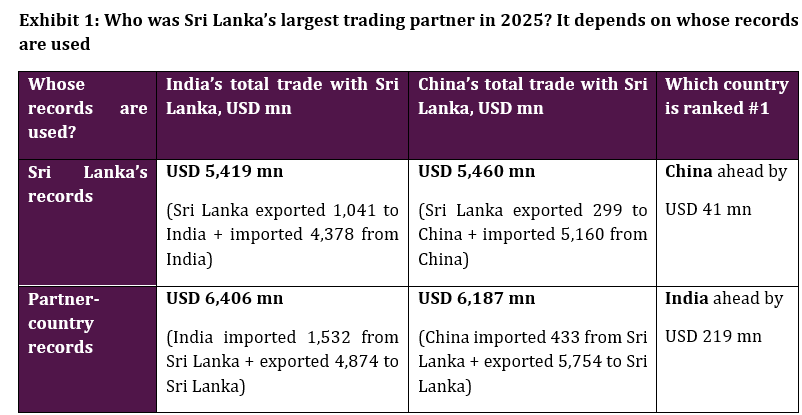
CBSL records Sri Lanka’s exports to, and imports from, partner countries as they are visible to Sri Lanka and registered through Sri Lankan customs. As shown in Exhibit 1, Sri Lanka’s total trade with China amounted to USD 5,460 million in 2025, while total trade with India amounted to USD 5,419 million. Therefore, using Sri Lanka’s own records, China was ahead of India by about USD 41 million. This supports Yu Jing’s claim that China became Sri Lanka’s largest trading partner in 2025.
However, the same trade relationship is also recorded by the authorities of the partner countries, India and China as it is visible to and counted by their institutions. These partner-country records count what India and China report as their exports to, and imports from, Sri Lanka. On this basis as shown in Exhibit 1, India’s total trade with Sri Lanka amounted to USD 6,406 million, while China’s amounted to USD 6,187 million. Therefore, using partner-country records, India was ahead of China by about USD 219 million. This supports Santosh Jha’s claim that India remained Sri Lanka’s largest trading partner in 2025.
Sources: CBSL, Annual Economic Review 2025; International Trade Centre Trade Map, https://www.trademap.org/, Department of Commerce, India, https://tradestat.commerce.gov.in/meidb/country_wise_all_commodities_export
Why do the two records produce different numbers?
In theory, Sri Lanka’s data on its exports to India and China should be mirrored in India and China’s data as imports from Sri Lanka, and vice versa for Sri Lanka’s imports from India and China. But in practice, there are differences, and in international trade statistics, these are known as mirror-data asymmetries.
The following are some major reasons why mirror-data asymmetries exist
- Valuation differences: Imports are usually recorded on a cost, insurance and freight basis, known as CIF. This includes the value of the goods plus transport and insurance costs. Exports are usually recorded on a free on-board basis, known as FOB. This usually excludes international transport and insurance costs. Because of this, the import value recorded by one country can be higher than the export value recorded by the partner country. The World Bank’s WITS guidance states that this can create a 10% to 20% difference between the values of mirror export and import.
- Timing differences: The same shipment may be recorded in different calendar years by the two countries. For example, the exporting country may record the goods when they leave in December, while the importing country may record them when they arrive in January.
- Triangular trade: Goods meant to be shipped directly between the exporting and importing countries may be sold through an intermediary (transit) country. This can lead either the exporting or importing country to record the intermediary (transit) as the trade partner instead of the actual source or destination of the goods.
- Temporary movements: Some goods move/cross borders temporarily for repairs, maintenance, leasing, exhibitions, trade fairs, or as returned goods. Countries may not count the movement of these goods in their trade statistics in the same manner. One country may record the movement as trade, while the other may exclude it from ordinary merchandise trade. Where goods are moved for repairs, one country may also record only the repair cost as a service export, rather than the full value of the goods as merchandise trade.
Where do the discrepancies lie between partner-country data and Sri Lanka’s data?
Discrepancies appear in both import and export data between the countries. Sri Lanka records lower imports from India and China than the exports reported by those countries to Sri Lanka. The larger discrepancy in the counting of data is on the exports from Sri Lanka as recorded by Sri Lanka.
In the case of India, Sri Lanka recorded exports of USD 1,041 million to India in 2025. By contrast, India recorded imports of USD 1,532 million from Sri Lanka. This means Sri Lanka recorded USD 491 million less in exports to India than India recorded as imports from Sri Lanka (See Additional Note 1 for export discrepancies with China).
On the product level, more than 80% of this USD 491 million difference was concentrated in five Harmonised System (HS) codes*: light-vessels, dredgers, floating cranes and similar vessels (HS 8905); other vessels, including warships and lifeboats (HS 8906); powered aircraft (HS 8802); excursion boats and similar vessels (HS 8901); and tugs and pusher craft (HS 8904). In four of the five categories, India recorded imports from Sri Lanka, but Sri Lanka didn’t record any corresponding exports to India. In one, the HS 8901 category, India recorded USD 135 million, while Sri Lanka recorded only USD 0.2 million in exports to India. Historical data show that such trends were observable for at least the past three years.
The most plausible explanation is that some of these entries reflect temporary movements, such as Indian vessels or aircraft being sent to Sri Lanka for repair, maintenance, or servicing before returning to India. The reason for the discrepancy is unknown – it’s possible that while India recorded these as trade in “goods”, Sri Lanka considered it as trade in “services” and not “goods”.
Conclusion
In light of the above analysis, it is accurate to say that: China ranks first in Sri Lanka’s data, while India ranks first in partner-country data. Because of the mirror data asymmetries, both these claims are supported in some way.
However, for the purpose of assessing between these claims, Sri Lanka’s own data is the more appropriate basis. Partner countries may apply different statistical standards to the same trade flows, as the mirror data asymmetries discussed above illustrate. Sri Lanka’s data, by contrast, treats all bilateral trade relationships using the same methodology, making it a consistent basis for comparison.
On that basis, in 2025, China was Sri Lanka’s “largest” trading partner, because Sri Lanka’s data shows Sri Lanka’s total trade with China, as being slightly higher than with India.
*The Harmonised System is a standardised numerical method of classifying traded products. It is used by countries around the world to uniformly identify and describe products for purposes such as assessing duties and gathering statistics.
Additional Note 1: Discrepancies in recording exports is visible in Sri Lanka’s trade data with China. In 2025, Sri Lanka recorded exports of USD 299 million to China, while China recorded imports of USD 433 million from Sri Lanka. Sri Lanka therefore recorded USD 134 million less in exports to China than China recorded as imports from Sri Lanka.
At the product level, a major recurring source of this difference is precious stones (HS 7103). Over the past five years, China has consistently recorded higher imports of precious stones from Sri Lanka than Sri Lanka has recorded as exports to China. In 2025 alone, Sri Lanka’s recorded exports of precious stones to China were USD 57 million lower than China’s recorded imports from Sri Lanka.
Similar, though smaller, gaps are also visible in other product categories. These include T-shirts and singlets (HS 6109), electrical transformers (HS 8504), and vegetable products not elsewhere specified (HS 1404). In these categories too, China recorded higher import values from Sri Lanka than Sri Lanka recorded as export values to China.
Sources:
Central Bank of Sri Lanka (CBSL), Annual Economic Review 2025: Statistical Appendix.
Available at: https://www.cbsl.gov.lk/sites/default/files/cbslweb_documents/publications/aer/2025/en/30_Statistical_Appendix.pdf
Accessed on: 19 May 2026.
International Trade Centre (ITC), Trade Map: Trade statistics for international business development.
ITC states that Trade Map provides import and export statistics by product group across more than 200 countries and territories.
Accessed on: 19 May 2026.
Sri Lanka Export Development Board (EDB), Online Trade Statistics Platform.
The EDB states that its online platform provides Sri Lankan export and import trade data, major export and import markets and related trade information, sourced from Sri Lanka Customs.
Accessed on: 19 May 2026.
World Bank, World Integrated Trade Solution: Imports, Exports and Mirror Data with UN Comtrade.
Supports the CIF/FOB explanation and the 10% to 20% mirror-value difference.
Available at: https://wits.worldbank.org/wits/wits/witshelp/content/data_retrieval/T/Intro/B2.Imports_Exports_and_Mirror.htm
Accessed on: 19 May 2026.
United Nations Comtrade, Guidelines on Analysing and Reducing Bilateral Asymmetry.
Supports the explanation on timing, partner attribution, re-exports, merchanting and bilateral asymmetry sources.
Available at: https://comtradeapi.un.org/files/v1/app/wiki/Guidelines_on_Analyzing_and_Reducing_Bilateral_Asymmetry-23_Apr_2019.pdf
Accessed on: 19 May 2026.
Eurostat, Beginners: Trade in goods, products and partners.
Supports the explanation on product classifications, partner-country reporting and trade-statistics asymmetries.
Available at: https://ec.europa.eu/eurostat/statistics-explained/index.php?title=Beginners%3ATrade_in_goods_-_products_and_partners
Accessed on: 19 May 2026.
Government of India, Ministry of Commerce and Industry, Department of Commerce (2026) System on India’s Monthly Trade: Export, Country-wise all Commodities. Available at: https://tradestat.commerce.gov.in/meidb/country_wise_all_commodities_export (Accessed: 22 May 2026).
This post is also available in: