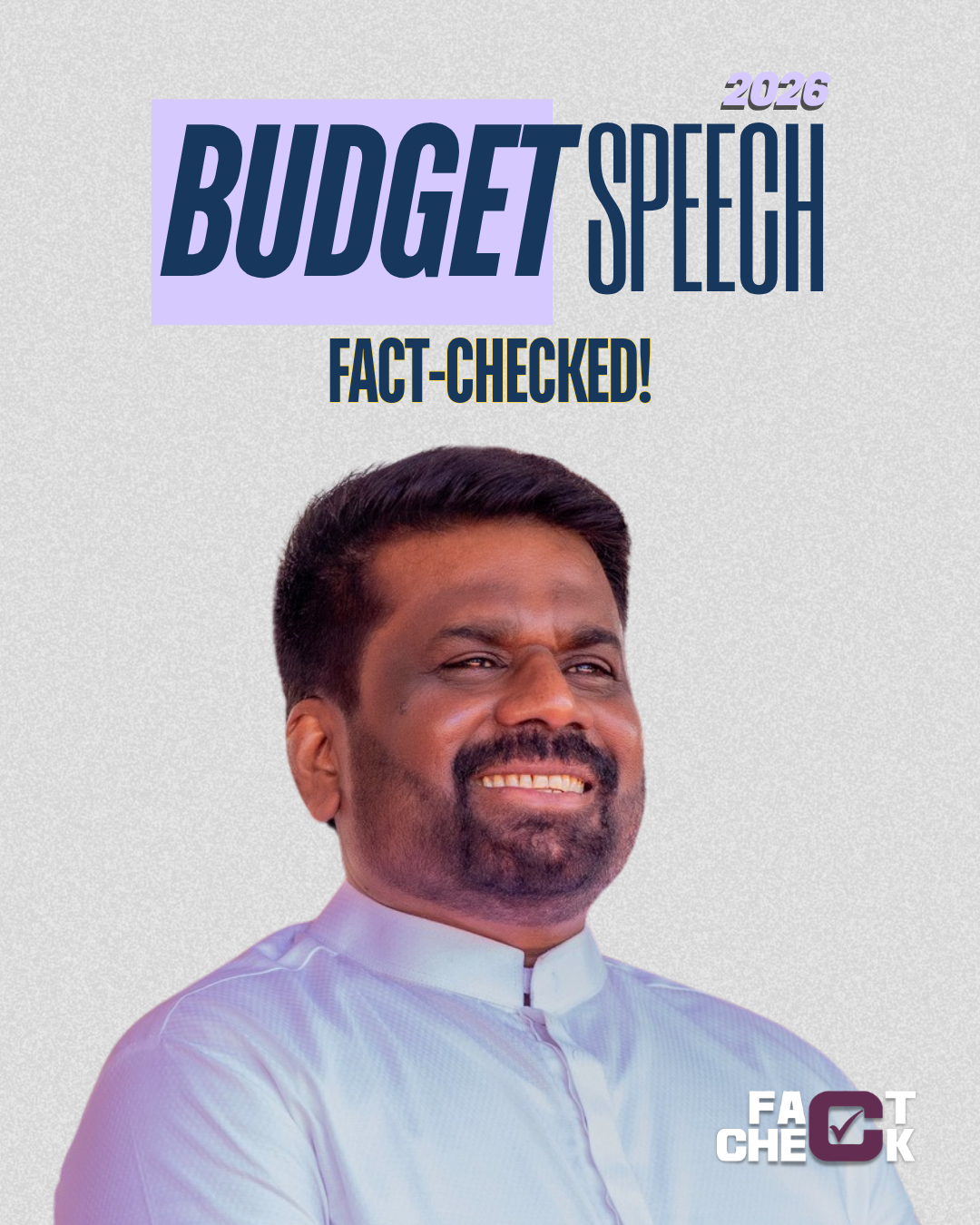
The team fact-checked a total of 3 statements from President Anura Kumara Dissanayaka’s 2026 budget speech. Of these, two statements were graded as True and one of them as Partly True.
Statement 1: Due to the strong growth in all sectors of the economy, the economy grew by 4.8% in the first half of 2025. Thus, it even exceeded the forecasts made by multilateral organisations.
President Anura Kumara Kumara Dissanayaka, 7 November 2025
Fact-check: By March/April this year, multilateral organisations—including the IMF, World Bank, and ADB—projected 2025 annual growth of between 3.0%, and 3.9%. In the first half alone, Sri Lanka’s economy grew by 4.8%, exceeding those yearly projections.
Statement 2: In 2026, the state income as a percentage of GDP will reach the closest it has come after two decades to the 16% registered since 2006.
President Anura Kumara Kumara Dissanayaka, 7 November 2025
Fact-check: In 2007 (which seems to be the intended reference year) Sri Lanka’s state revenue was 16.6%. Since then, revenue has declined and has always been below 16%, and by 2022 as low as 8.5%. Therefore, the current revenue expectation of 15.3% for 2026 is the highest since 2007.
Verdict: TRUE
Source: Central Bank Annual Economic Review 2024 - Special statistical appendix
Statement 3: …I wish to tell you that we will be able to reach the pre-crisis economic state by the end of 2025.
President Anura Kumara Kumara Dissanayaka, 7 November 2025
Fact-check: Elsewhere, the President anchors the “pre-crisis economic state” as the year 2019 (prior to the debt-default, and the COVID-19 pandemic).
Since the president did not define the key measures of economic health, we assessed his claim on four major economic indicators relevant to Sri Lanka’s crisis and recovery: total output (GDP), poverty, employment and foreign reserves.
GDP: Under the revised 2025 budget projections, Sri Lanka’s GDP is expected to have recovered up to LKR 32,036 billion, which in real terms is equal to 98.7% of the GDP in 2019.
Poverty: The government has not updated its poverty statistic of 14.3% from 2019. Using the alternative World Bank estimate that is often quoted by the government, the 2019 figure compared to its estimate of the same for 2025 shows poverty as still being almost double the 2019 level, and therefore nowhere near to full recovery yet.
Employment: The standard measure, which is the “share of employed in the 15+ population”, has fallen from 50% in 2019 to 47.5% in the second quarter of 2025. That is a shortage of around 430,000 odd jobs to reach the pre-crisis (2019) level.
The change in the unemployment rate, often cited, is unsuitable for this evaluation of economic recovery because of how that statistic is defined. If people cannot establish that they were actively looking for jobs, they get counted as “not in the labour force” and not as unemployed.
Reserves: Central Bank foreign reserves are projected to reach USD 7.2 billion, compared to USD 7.6 billion at end 2019.
The macroeconomic indicators (GDP and reserves) are nearing pre-crisis benchmarks, yet the socio-economic indicators (employment and poverty) lag significantly.
VERDICT: PARTLY TRUE
UPDATETO FACT-CHECK OF STATEMENT 3 (November 19, 2025)
Fact-check: Elsewhere, the President anchors the “pre-crisis economic state” as the year 2019 (prior to the debt-default, and the COVID-19 pandemic).
Since the president did not define the key measures of economic health, we assessed his claim on six major economic indicators relevant to Sri Lanka’s crisis and recovery: total output (GDP), poverty, employment, foreign reserves, public debt to GDP ratio, and interest cost to revenue ratio.
GDP: Under the revised 2025 budget projections, Sri Lanka’s GDP is expected to have recovered up to LKR 32,036 billion, which in real terms is equal to 98.7% of the GDP in 2019.
Poverty: The government has not updated its poverty statistic of 14.3% from 2019. Using the alternative World Bank estimate that is often quoted by the government, the 2019 figure compared to its estimate of the same for 2025 shows poverty as still being almost double the 2019 level, and therefore nowhere near to full recovery yet.
Employment: The standard measure, which is the “share of employed in the 15+ population”, has fallen from almost 50% in 2019 to 47.5% in the second quarter of 2025. That is a shortage of around 430,000 odd jobs to reach the pre-crisis (2019) level.
The change in the unemployment rate, often cited, is unsuitable for this evaluation of economic recovery, because of how that statistic is defined. If people cannot establish that they were actively looking for jobs they get counted as “not in the labour force” and not as “unemployed”.
Reserves: Central Bank foreign reserves are currently at USD 4.8 Bn (when gross official reserves are correctly measured, excluding unusable swaps). This is 38% lower than the USD 7.6 bn in 2019 (with gross official reserves measured the same way, excluding unusable swaps).
Public Debt to GDP: The latest published official estimate of public debt to GDP at the end of 2025 is 97% (after increasing to 123% in 2023), this is close to the Central Bank’s updated record of public debt to GDP in 2019 of 94%.
Interest Cost to Revenue: Budget 2026 projects interest cost to revenue at 49%, which is close to the 2019 level of 47%.
Overall, three of the six indicators (GDP, interest cost to revenue, and debt-to-GDP) are nearing pre-crisis benchmarks, while the remaining three indicators (employment, poverty, and reserves) continue to lag significantly behind.
VERDICT: PARTLY TRUE
Sources: National Accounts Estimates of Sri Lanka, Department of Census and Statistics
We use cookies on our website to give you the most relevant experience by remembering your preferences and repeat visits. By clicking “Accept All”, you consent to the use of ALL the cookies. However, you may visit "Cookie Settings" to provide a controlled consent.
This website uses cookies to improve your experience while you navigate through the website. Out of these, the cookies that are categorized as necessary are stored on your browser as they are essential for the working of basic functionalities of the website. We also use third-party cookies that help us analyze and understand how you use this website. These cookies will be stored in your browser only with your consent. You also have the option to opt-out of these cookies. But opting out of some of these cookies may affect your browsing experience.
Necessary cookies are absolutely essential for the website to function properly. This category only includes cookies that ensures basic functionalities and security features of the website. These cookies do not store any personal information.
Any cookies that may not be particularly necessary for the website to function and is used specifically to collect user personal data via analytics, ads, other embedded contents are termed as non-necessary cookies. It is mandatory to procure user consent prior to running these cookies on your website.